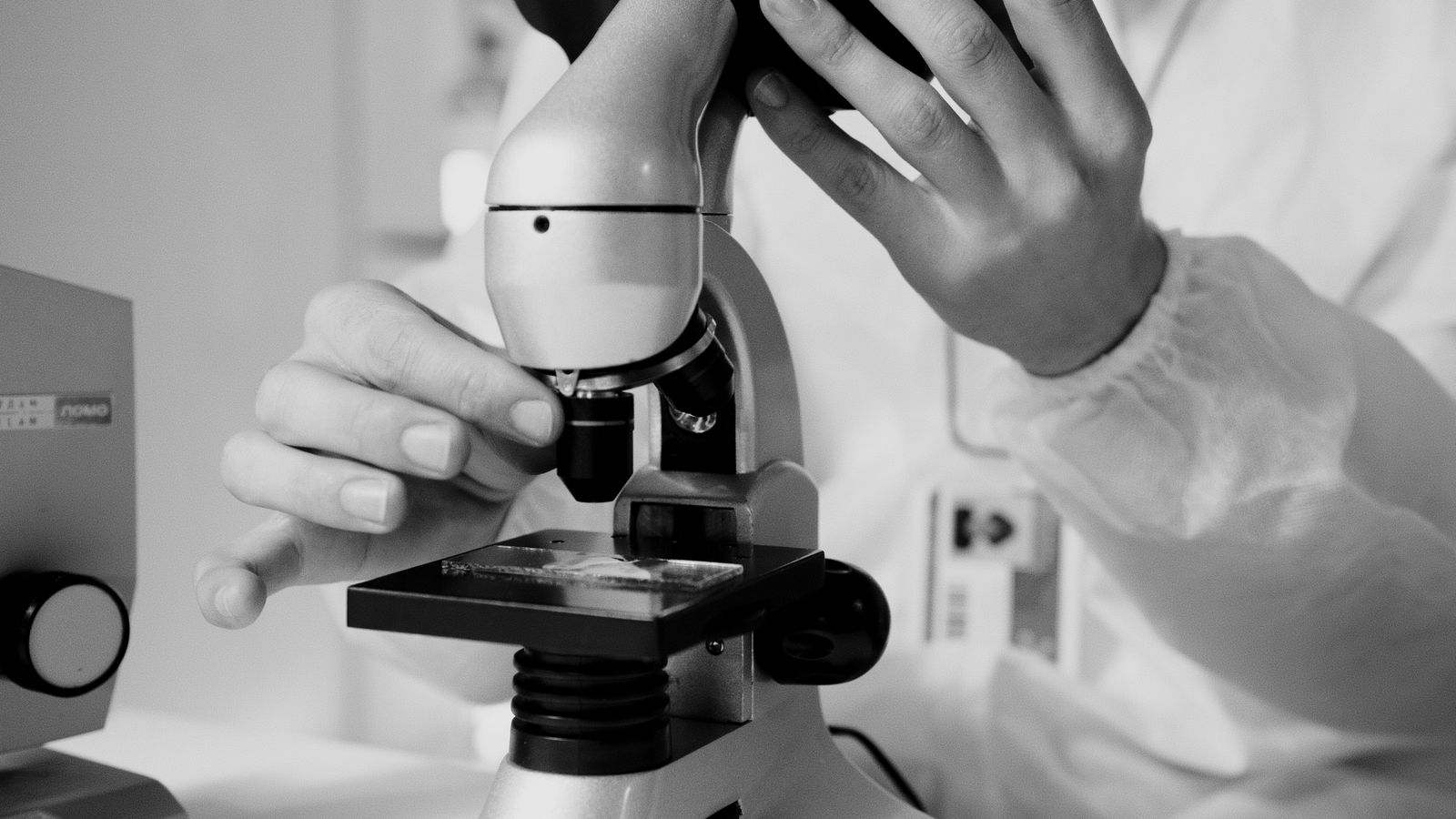
What FTD actually demands of your microscope, your equipment and your room — refined over four decades of installations, so nothing surprises you after the crate arrives.
FTD work is carried out at two magnifications: a low-power objective locates good candidate grains, and very high magnification counts tracks and measures their lengths. It is done in bright-field mode using both transmitted and reflected light — transmitted light gives good images of complete tracks, while reflected light accentuates the etch-pit entrances.
Immersion oil is not used (except for zircon work): its refractive index is so close to that of mica and apatite that it makes the tracks disappear entirely.
One essential item — which many microscopy laboratories already own — is a high-quality stage micrometer: a standard slide engraved with very accurately spaced lines, indispensable for calibrating the system's components. We supply one with every full system. An eyepiece graticule (the traditional counting aid) is still fitted as a complimentary item, though it is rarely needed now that almost all work is done on-screen.
Dual large-format monitors allow simultaneous large-image viewing of grain and mica mounts; as an option we supply a single large curved monitor that carries all windows on one screen, saving bench space.
For the automatic track counting module in Trakscan Plus to function properly, six items are essential:
Automated counting works by capturing and analysing a multitude of detailed images. The motorised microscope ensures those images are captured properly; the camera and PC ensure they carry enough information and are processed fast enough. All three come correctly specified with every Trakscan Plus system — we prefer to supply the computer ourselves, with all microscope, stage, camera and analysis software installed and tested, so one supplier stands behind the whole system rather than mutual finger-pointing when something misbehaves.
Most laboratory floors move a surprising amount. At the 1000× magnification used in FTD, those vibrations shake the image and destroy the information needed for accurate counting. An effective solution need not be expensive: a suitably large slab of granite on a resilient base — even partially inflated wheelbarrow inner tubes — performs remarkably well. See our anti-vibration guide for a commercial option and two proven DIY designs, including complete drawings shared by Dr. Ulrich Glasmacher of Heidelberg University.
The automatic counting software requires the top and bottom surfaces of the grain mount to be absolutely parallel and smooth, which calls for high-quality grinding and polishing equipment. Professor Gleadow's laboratory at the University of Melbourne has the necessary equipment and documented procedures — contact us for details and an introduction.
A thin metallic coating deposited on the grain mount surface eliminates spurious reflections from near-horizontal tracks just beneath the surface, which would otherwise falsify the count. We are happy to advise on suitable facilities and procedures.
We can advise on every item on this list — including the ones we don't sell.